

The Rackstad Colony
The Rackstad Colony 1898-1920
The Arts & Crafts movement by lake Racken
When the first of the colony’s artists arrived in 1898, no one could have imagined the history that would be shaped here. The meeting between their modern ideas and the craftsmanship that was already well established in Arvika created a melting pot for arts & crafts, largely thanks to their cooperative spirit and sense of community.The village of Rackstad, from which the group took its name, eventually became home to many of the young artists. But it was on the current site of Rackstad Museum that it all began.
At that time there was a furniture workshop here, Bröderna Erikssons Möbelverkstad, the output from which had quickly built up a strong reputation at leading exhibitions in Sweden and worldwide. The younger brother, Christian Eriksson, also had a studio home built here, known as Oppstuhage, when he returned from Paris. When he left Arvika for Stockholm in 1898, the studio was let,first to the Fjæstads, a young artist couple, and then to other artists who wanted to create a new life in Arvika.
Rackstad Museum is now home to the largest collection of work by this colony of artists. Here, we tell the tale of a group of people who sought happiness and success beyond the big cities. Filled with influences from the outside world, their work reflected an ongoing dialogue between regional and international influences, the contemporary and the traditional.
The artists around lake Racken did not identify themselves as a distinct group; they refused to be pinned down by manifestos or a grand shared vision. Their common belief in the vitality of art is not revealed in words, but in their work.
They differ in this respect from say William Morris, with his well-formulated ideal of Arts & Crafts as a socially disruptive challenge to industrial society.
Many of the colony’s members shared similar ideas, not uncommon at the time. But it is hard to find any clear political leanings in their art.
Their collaborative efforts in different materials and techniques, their resistance to the prevailing definitions that distinguished art from art & crafts, and a belief in the hand-crafted object are what made the Rackstad Colony a unique oasis for Swedish Arts & Crafts for several decades.
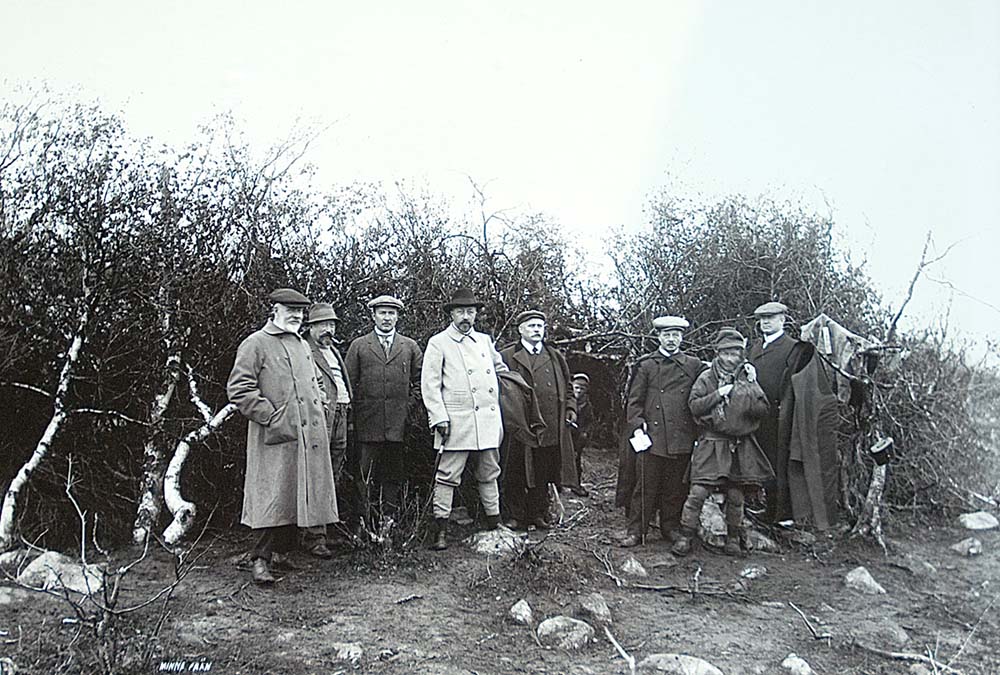
The artists that began their work in the 1890s were strongly influenced by the new ideas of the revolutionary Konstnärsförbundet (the Artists’ Union). The young artists Maja Hallén and Gustaf Fjæstad, who recently had become a couple, belonged to a group that was greatly influenced by the new ways of portraying one’s surroundings demonstrated by Carl Larsson and Bruno Liljefors, among others. Gustaf worked from time to time as an assistant to both Larsson and Liljefors to produce the frescoes at the Swedish Nationalmuseum and the Biological Museum. When Christian Eriksson left Arvika in 1898 and moved to Stockholm, he met Maja and Gustaf. The couple, who were about to get married, were looking for a studio and a home. But the housing situation in Stockholm was, to say the least, challenging for young, unestablished artists.
Christian offered his modern studio home Oppstuhage, in Arvika, for a small rent and the Fjæstads quickly accepted the offer. It must have been a dramatic change of lifestyle for the young couple, but Gustaf, who had previously travelled in Värmland, had fallen in love with the county and its nature. There was a trend at the time among Swedish artists to leave the big cities for the countryside, and work closer to the landscape that they loved.
They married in Maja’s native region of Väsby in Skåne, in the summer of 1898, and soon after the couple moved into Oppstuhage, with the Eriksson brothers as their nearest neighbours. The artisans in the area were already used to collaborating with artists through Christian’s work. Soon the Fjæstads would start designing furniture, which were manufactured in the furniture workshop, as well as designing lamps that were made by the blacksmiths at Myra. During those early years in Arvika there were many visits from friends and fellow artists, and several of them were fascinated by the opportunities and the landscape that Värmland offered. One of them was Björn Ahlgrensson, newly engaged to Elsa, sister of Björn’s good friend Fritz Lindström. In 1901, the Ahlgrenssons left Stockholm to settle in Arvika, and a couple of years later the Lindströms also followed. Oppstuhage became a stopover for many of the newly arrived artists while they searched for their own homes. Christian’s studio home remained a hub for the colony for many years. Art classes were held there and it was often a place for parties.
Gustaf Fjæstad had frequently visited lake Racken in 1899, a few kilometres north of Oppstuhage, where he came across many of his subjects. At the southern edge of the lake, on a headland in the small village of Rackstad, there was a plot of land for sale. The Fjæstads bought it and designed their own home at Kampudden, which was completed in 1901. Around the same time the Ahlgrenssons also moved to nearby Pershaget, and more and more artists soon came to settle around Racken.
Dramatic changes took place in Nordic art during the 1880s and 1890s. In Sweden, this took the form of growing opposition by Opponenterna (the Opponents) and Konstnärsförbundet (the Artists’ Union) to the established conventions of the Royal Swedish Academy of Fine Arts, but there were similar revolts in neighbouring countries over the same period. In the 1880s, large numbers of Swedish artists flocked to Paris, where they were exposed to new attitudes towards artistic freedom and integrity.
The debates were lively and this was a very productive time for many artists. The Impressionists had already distanced themselves from traditional historical painting and had instead begun to portray everyday life. They turned their eye to subjects such as the landscape, workers or the decadent lifestyle of the upper class. At times this reflected a conscious criticism of the establishment, but perhaps most of all it was the freedom to express the artist’s own interpretation of their surroundings that broke the norm. It helped to shift the perception of the artist from documentary observer to an exploratory and active participant in social debate. Björn Ahlgrensson, Fritz Lindström and Christian Eriksson (members of the Artists’ Union) were among those who saw and learned a great deal during their time in Paris.
Eriksson lived in Paris periodically for many years, while Ahlgrensson mostly grew up in the French capital, which must have felt more like home than Sweden. Many of the French artists had begun to work outside their studios. They took their paint boxes and canvases into the outside world to work as closely to their subjects as possible. This outdoor painting was known as plein air in French, or friluftsmåleri in Swedish. Many of the Swedish artists took this practice home with them and began to depict Sweden’s cafés, nightlife and landscapes.
Paris was also a nursery for many new styles in both painting and sculpture. These styles considerably more liberated in their expression than had been possible at the Royal Swedish Academy of Fine Arts, and left more room for artistic integrity.
Christian Eriksson was strongly influenced by figures such as Alexandre Falguière and Auguste Rodin, whose work meant more freedom in the use of techniques and materials than was customary in the traditional decorative sculptural tradition.
Other styles that are reflected in the work of the Rackstad Colony and had a major impact in Paris were Art Nouveau and pointillism, where the subject is partly or entirely built up using short “dotted” brushstrokes.
For many of the members of the Rackstad Colony, the central role of art was to create happiness and well-being for the person who acquired the crafted object. Ellen Key’s book “Skönhet för alla’” (Beauty for All) was published in 1899 and advocates the importance of the beautiful home for human well-being. She visited the artists in Arvika on several occasions.
Key had been influenced by the British Arts & Crafts movement, led by John Ruskin and William Morris. This movement opposed the growing standardization of manufacturing methods for household goods, and aimed to restore the importance of craftsmanship.
Beauty in everyday life was a subject of debate in Sweden around the turn of the century and was regarded by its supporters as a question of democracy and a right of the people.
In Britain, the movement was strongly influenced by Marxism and clearly politicized. The Rackstad Colony never formulated a joint manifesto for art or for politics. Nor did the individual artists declare any strong political affiliation in connection with their art. Nevertheless, the ways they worked clearly expressed the importance of the handmade object. In Arvika, collaboration between workshops was encouraged, and many artisans were keen to improve their skills in a variety of crafts. They were able to seek help from colleagues to learn skills such as potting or shaping metal bowls. Often an artist would design an object which was then crafted by another who had more skill in the chosen material.
Maja Fjæstad worked hard to create the right conditions for Arvika’s artists and craftspeople. She was a central figure, both socially and professionally, and sometimes set aside her own artistic ambitions to support her colleagues.
In 1922 she became one of the founders of the cooperative Arvika Konsthantverk (Handicraft in Arvika) with the aim of bringing the craftspeople of the region together under one roof, a collective project that would both support sales by individuals and at the same time give the public access to more beautiful household goods. Maja was elected chairman of the cooperative and remained in that role for 26 years. The association and the store still live on under the same name.
As Japan gradually opened up to trade from 1854 onwards, there was growing Western interest in the unique arts and culture that the country had to offer. Ceramics and visual arts were soon exported on a large scale to Europe and appeared frequently in exhibitions and magazines during the late 19th century.
The design language was flowing, stylized and unencumbered by Western conventions of how perspective and shadows should be expressed in art. The art form that gained the greatest popularity was the woodblock prints of Ukiyo-e, “images from the transient world”; and several examples could be seen in the Fjæstads’ family home.
The prints convey an ancient history with roots in Buddhist philosophy, but in Europe and Sweden they became the height of fashion. In particular, the organic forms that seemed to capture the essence of nature’s life force influenced the burgeoning Art Nouveau, or Jugendstil as it came to be known in Sweden. Distinct contours and sinuous forms also began to appear beyond the visual arts.
The influence of Japonism on the Rackstad Colony is clear in its furniture, ceramics and wrought iron. The stylized shapes and distinct fields of colour were particularly suited to the textile works that Maja and Gustaf Fjæstad designed during the early 20th century.
Beyond art, the Fjæstad family, including Amelie and Anna, became interested in theosophy, an esoteric doctrine with a perspective on life that combines Christian, Buddhist and Hindu traditions. The family played a part in the founding of Arvika’s theosophical society and immersed themselves in the literature and lectures of figures such as Helena Blavatsky and Rudolf Steiner, who were the leading lights of the esoteric movement at the time.
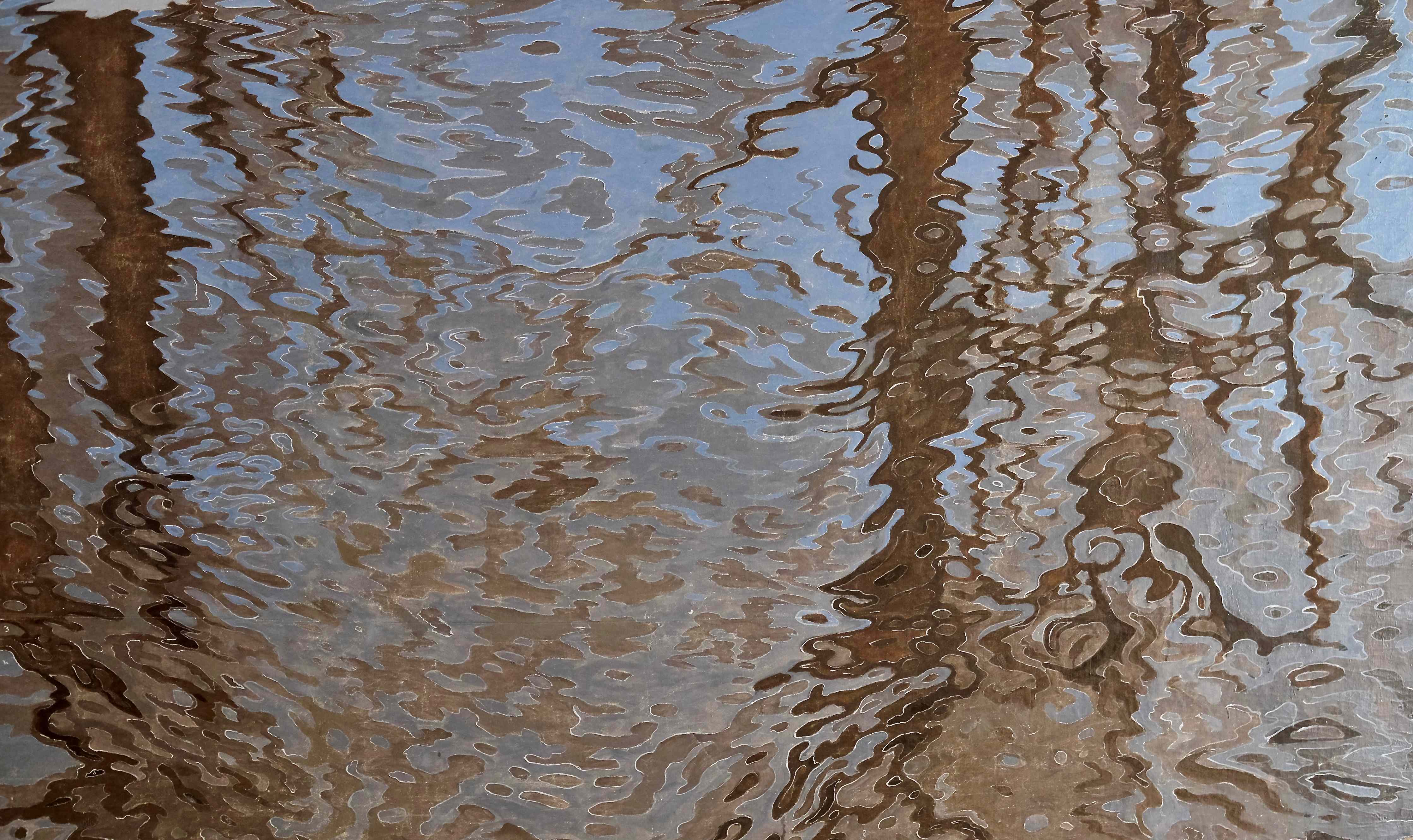
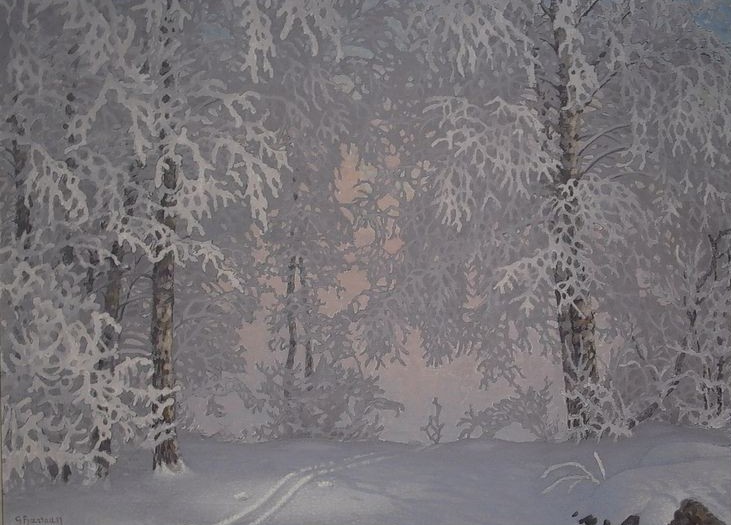
In the imagery of Gustaf Fjæstad he constantly returns to the subject of water. This often takes the form of ice, snow or water flowing from Racken down the Viksälven river.
Water is a recurring theme in theosophy as a symbol of the essence of life, whose power is believed to exist in every aspect of nature and man, and is constantly reincarnated in new forms. Gustaf Fjæstad himself never expressed such reasoning in connection with his art, but he was well acquainted with these ideas. Traces of people can be seen in many of his winter paintings, although the figures rarely remain in the scene. They seem to have disappeared into the landscape to become part of something greater.
As the second decade of the 20th century drew to a close, the vibrant artists’ colony at lake Racken had worked intensely together for 20 years. Some of the artists had experienced great success, while others lived in poverty and were doubtful of their own ability. Nevertheless, it was the shared sense of creativity that helped put Lake Racken on the map, shaped their style and provided opportunities to exhibit in fine salons.
The closing years of the 1910s were difficult for many of the artists, just as they were for the rest of the world, as the war seemed never-ending and the Spanish flu pandemic took its own toll. For some, the rural idyll that had captured their hearts may have seemed to be slowly vanishing. Björn Ahlgrensson, who had been an important figure in the colony but had not achieved commercial success with his work, had already left Arvika in a desperate attempt to realize his dreams. When he later returned, he was ill with both tuberculosis and Spanish flu. He died in 1918 at the sanatorium in Arvika. In the same year, the Fjæstads decided to leave Rackstad and move to Lidingö, close to their colleague Carl Milles.
The Fjæstads returned to Arvika just a few years later, but by then the original dynamic of the colony had changed. Maybe the artistry that flourished at the beginning of the century had run its course. With the advent of modernism in Sweden, new names were now appearing on the exhibition posters, such as Isaac Grünewald and Einar Jolin.
A new era had arrived, drawing new artists to Arvika, both local talent and those from further afield. Under the leadership of Maja Fjaestad several of the region’s artisans also became involved in the newly formed Arvika konsthantverk (Handicraft in Arvika). The store opened in 1924 and came to provide a showcase for new generations of textile artists, blacksmiths, potters, etc.
The music that has always had a vital place in the life of the artists’ colony also underwent a renaissance when the Folkliga musikskolan (Popular Music School) opened the following year, today Ingesund School of Music/Karlstad University.
The achievement of the artists at Rackstad Colony cannot be summarised solely by the objects they left behind. They helped to create a belief in art and an identity in Arvika that firmly links it with cultural expression. It has resonated through the generations and continues to do so today.
Artists and craftsmen
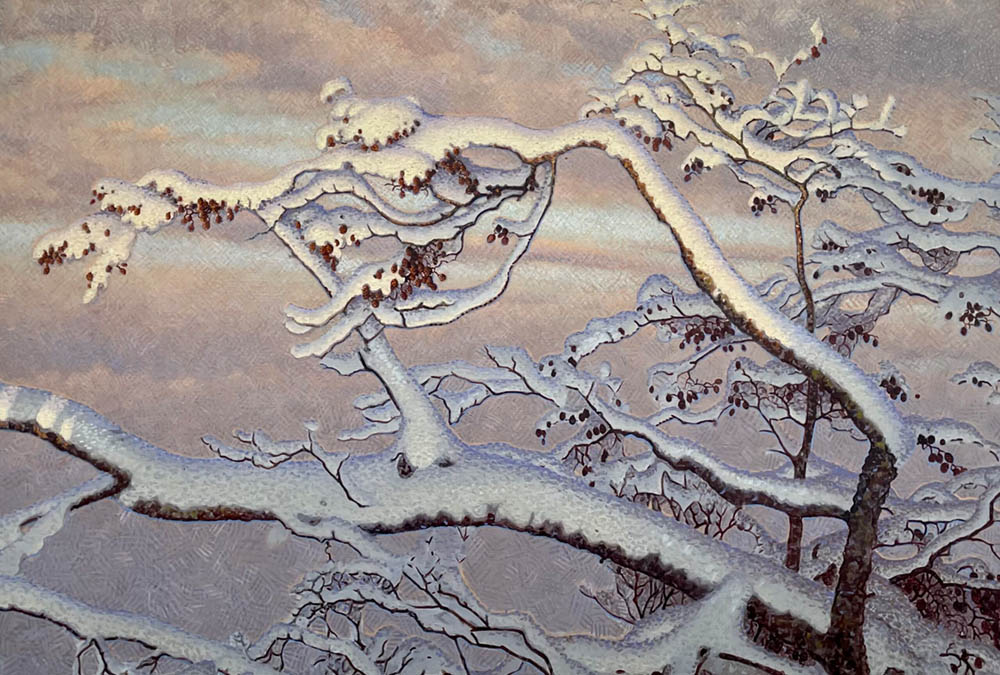
Gustaf was born in Stockholm and trained at the Royal Swedish Academy of Fine Arts and the Artists’ Union school. He was a successful sportsman in both cycling and skating. Gustaf assisted when Bruno Liljefors painted dioramas at Biologiska museet, and when Carl Larsson created wall paintings at Nationalmuseum. In summer 1898, newlyweds Gustaf and Maja came to Oppstuhage in Taserud, which they had rented from their friend Christian. Gustaf eventually designed and built his own artist’s home at Kampudden by Lake Racken. Gustaf Fjæstad concentrated on shimmering landscapes in pointillist style and is primarily associated with motifs of winter, water and snow, often being called “the master of hoarfrost”. His depictions of the Nordic landscape and light received great international attention.
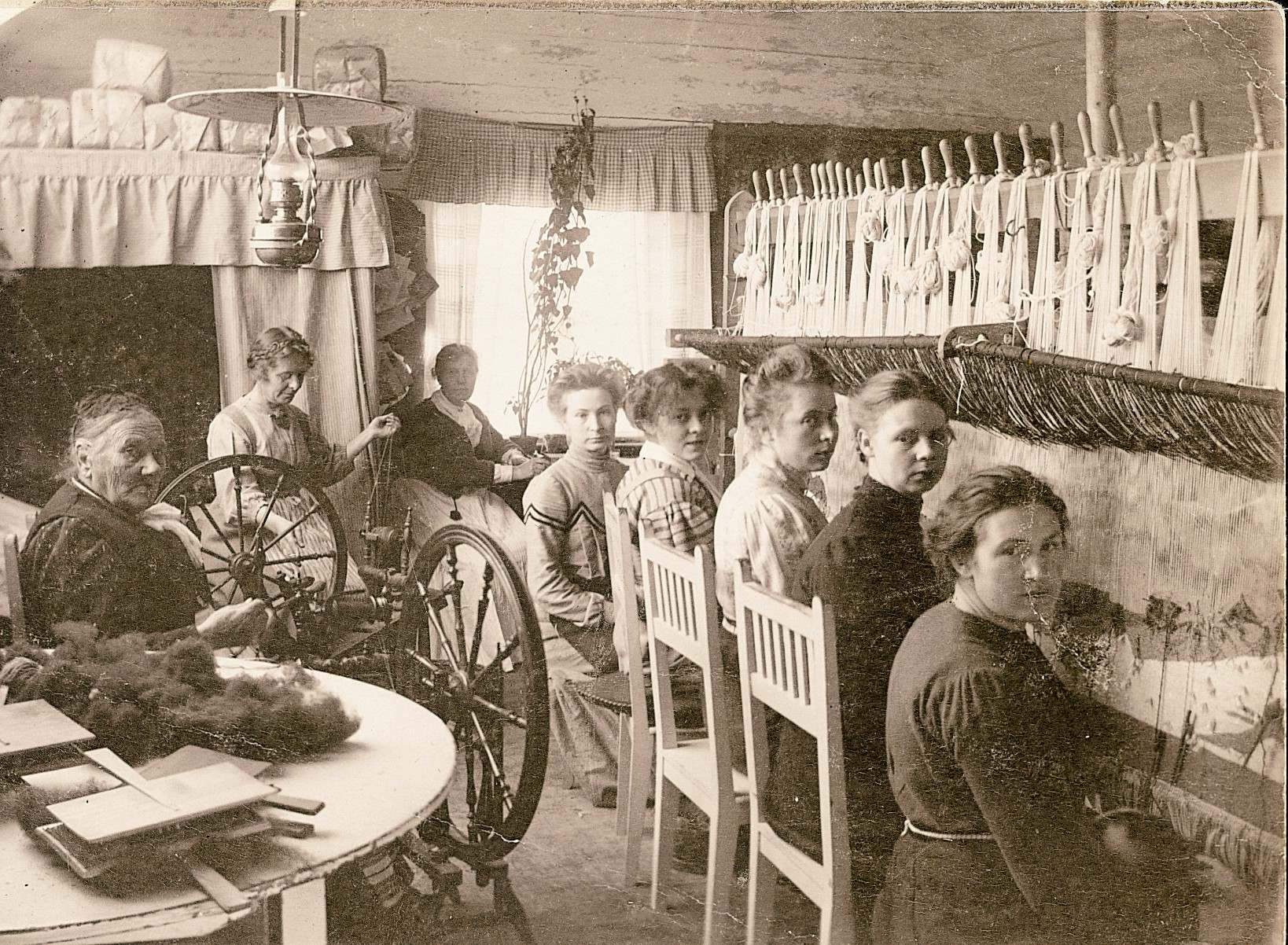
Maja (Maria) Hallén was born in the Skåne town of Hörby. She trained in textiles and then painting at the Artists’ Union school in Stockholm. In 1898, she married Gustaf Fjæstad and the couple moved into Christian Eriksson’s Oppstuhage. After a few years, the family moved to Kampudden, by Lake Racken. There she later founded Fjæstad’s Weaving Workshop, together with a weaving school. She was a versatile artist who worked with painting, textiles and later even wood and lino cuts with plant motifs. Her designs were stylised and suited both wood and textiles. Maja organised exhibitions, wrote articles and in 1922 was involved in creating Arvika Konsthantverk.
Björn Ahlgrensson was born in Stockholm but grew up in Paris. During his training as a decorative painter, he met his friend Fritz Lindström. He then trained at the Artists’ Union school and was influenced by the trend for atmospheric landscape paintings. Gustaf and Maja Fjæstad encouraged him to move to Arvika, where he settled in Perserud by Lake Racken in 1901 as a newly married man. There he painted a long series of paintings with melancholy twilight motifs. His most famous work is “Skymningsglöden” (The Twilight Glow), from 1903. During his lifetime, he was relatively unknown. He died from Spanish flu in 1918 in the sanatorium in Arvika.
Fritz was born in Stockholm and started his artistic career as a decorative painter. During his training at the Artists’ Union school, he met his friend Björn Ahlgrensson. He continued his studies at Valand in Gothenburg, followed by Copenhagen and Paris. In 1903, after his friend Björn had married Fritz’s sister Elsa and moved to live by Lake Racken, Fritz also came to Arvika, where he stayed. He painted landscapes and portraits. Two of his most well-known paintings are “Vid elden” (By the Fire) from 1905 and a portrait of Ivan Aguéli from 1898. When Fritz Lindström died in 1962, he was the last of the painters around Racken in the generation educated by the Artists’ Union.
Hilma Persson grew up in Rackstad but moved to Stockholm in 1899 to study. She took evening courses at Högre Konstindustriella Skolan while simultaneously working at Rörstrand porcelain factory, making figurines and decorating Christmas plates. After further travel to study overseas, she returned to Arvika in 1907 and started a pottery workshop. She married potter Rolf Hjelm. Hilma was inspired by the decorative Art Nouveau style and her vases, urns and platters were decorated in relief with insects, pine cones, flowers and leaves. She also worked as a drawing instructor at Arvika vocational college. Hilma was well-known and appreciated for her artistry, and her objects were often presented in exhibitions.
Bror Lindh came from a large family of painters in Frykerud, in Värmland. He initially trained in his father’s studio, before moving to Arvika and continuing his studies with Gustaf Fjæstad. In 1899, he began studying at the Artists’ Union school in Stockholm. He returned to Arvika after what is said to have been an unhappy love affair and joined the Rackstad Colony, but often lived very simply and in solitude. His painting was often inspired by Japanese art – decorative with a flat perspective, but simultaneously atmospheric tributes to nature with an exciting play of light. One of his most famous works is Moonshine.
Amelie and Anna were the elder sisters of Gustaf Fjæstad and were born in Stockholm. After their father’s death, the sisters and mother moved to Örebro and started a dressmaker’s studio. Following encouragement from their brother, in 1905 they moved to Rackstad, and began to focus on weaving. The two women built a house combined with a weaving studio at Kampudden, next door to Gustaf and Maja, who founded both Fjӕstad’s Weaving Workshop and a weaving school, where the sisters worked. The sisters were often called “Anna the hands” and “Amelie the ideas”. They wove and composed their own patterns in a range of techniques, but also wove textiles based on Gustaf and Maja Fjӕstad’s patterns and sketches.
Bror was born in Utterbyn, Torsby in Värmland, the son of Member of Parliament Per Sahlström. He trained at Tekniska Skolan in Stockholm before continuing his studies as a sculptor around Europe. For a couple of years in the late 1890s he lived in Paris and worked as an assistant to Christian Eriksson. He returned to Värmland, and moved to Arvika. In the period 1904–1906, Bror Sahlström rented a studio at Oppstuhage. He worked in many different techniques and styles – furniture design, silver work, portrait busts, reliefs and sculptures. His work can be seen in Arvika, for example the baptismal fonts in Trefaldighetskyrkan and Mikaelikyrkan.
Lisa (Ester Elise) Andersson was born in Grava in Värmland. In the early 1900s, after she had completed her studies at the girls’ school in Arvika, she travel to America to study at the New York School of Art. She then continued her studies in Europe before moving back to Arvika in 1908. She was a metalworker, and has become known for her richly decorated platters, sconces, dishes and chandeliers in chased copper, brass, gold and silver. In 1914 she married Carl Ernst Morell. Lisa Morell was known as “Copper Lisa”. As well as engraving and chasing, she painted miniatures and made wood and lino prints.
Petter på Myra (Petter Andersson) was born in Gunnarskog and was a school friend of Elis and Christian Eriksson. He came from a family of craftsmen and was apprenticed to his father, who was a smith. The smithy primarily produced everyday ironwork, but this became more decorative as the collaboration with Bröderna Erikssons Möbelverkstad grew. Petter på Myra’s production included furniture fittings, chandeliers, railings and grilles created to drawings by the most important architects and artists of the time. His work can be found in Stockholm Courthouse, at Skogskyrkogården and Millesgården in Stockholm. Petter på Myra became one of the most skilful artist blacksmiths of his time, working in both iron and copper.
Ragnar Myrsmeden (born Pettersson) came from Arvika and was the son of the smith Petter på Myra. Ragnar continued the family tradition, being apprenticed to his father and becoming a smith. He continued his training at the Society of Crafts and Design in Gothenburg in 1907–1908, before taking study trips to Italy and Germany. In 1918, he travelled to Stockholm to produce decorative metalwork for the City Hall, which was then under construction. He primarily worked with chasing copper. Ragnar took the name Myrsmeden, married Tora, a carpenter’s apprentice, and they settled in Stockholm. He made the carillon designed by Stig Blomberg for Halmstad Courthouse, and parts of the Freedom Monument in Riga.